


Vanilla Knowledge
The Science of Vanilla Curing: Why Three to Six Months Changes Everything
Jun
A freshly harvested vanilla bean has almost no flavour. Snap one open straight from the vine and you will find moisture, a faint green scent, and none of the deep, complex aroma we associate with vanilla. The curing process — 4 sequential stages spanning 3 to 6 months — is where that flavour is built from scratch.
Blanching → Sweating → Drying → Conditioning
Triggers enzymatic vanillin release
Traditional sun-curing method
Why a Green Bean Contains Almost No Vanillin
Understanding how vanilla beans are made starts with the bean’s chemistry at harvest. The green bean contains glucovanillin — a locked, flavourless precursor — rather than free vanillin itself. The vanillin molecule (C8H8O3) is chemically bound to a glucose unit and cannot be detected by smell or taste in this state.
The enzyme β-glucosidase is present in the same bean tissue, but it is physically separated from glucovanillin in intact cells. Only when cellular membranes are disrupted — through heat, wilting, or mechanical damage — do enzyme and substrate meet. That collision triggers the chain of reactions that produces free vanillin (Havkin-Frenkel & Belanger, 2011).
Indonesia produces approximately 2,300 tonnes of vanilla annually, ranking second globally after Madagascar (FAO). Every one of those kilograms starts its flavour journey in this exact moment of enzymatic release.
Green vanilla beans at harvest — 9 months on the vine, flavour still locked inside
Stage 1 — Blanching at 60–65°C: The Trigger That Starts Everything
Blanching is the first of the 4 curing stages, and the most time-critical. Freshly harvested beans are submerged in water heated to exactly 60–65°C for 20 to 30 seconds. This narrow temperature window matters precisely: below 60°C, the enzyme stays insufficiently activated; above 70°C, β-glucosidase denatures and the reaction stops permanently.
The heat shock ruptures cell walls across the bean. Enzyme meets substrate in every cell simultaneously. Glucovanillin begins converting to free vanillin within minutes. The beans turn dark brown almost instantly — the visible sign that the reaction has started.
At Vanillature, our farmers in North Sumatra — working at 680 metres above sea level — use traditional wood-fired blanching baths calibrated by generations of experience. No shortcuts, no artificial accelerants.
Stages 2 and 3 — Sweating and Drying: Building the Flavour Profile
After blanching, the beans enter the sweating stage. Farmers wrap them tightly in wool blankets or place them in sealed wooden chests for 36 to 48 hours at a time. Internal temperatures hold between 45°C and 55°C. This prolonged warmth continues the enzymatic conversion and begins concentrating the developing aromatic compounds.
Sweating cycles repeat for 1 to 2 weeks. Each cycle draws moisture out progressively. This is also where secondary flavour compounds — including heliotropin (piperonal) and vanillic acid — develop alongside vanillin, contributing the layered complexity that single-compound synthetic vanilla cannot replicate.
Sun-drying follows. Beans are spread on raised racks and exposed to direct Sumatran sunlight for 3 to 5 hours each morning, then covered or brought inside before the afternoon humidity peaks. This daily cycle continues for 4 to 8 weeks until moisture reduces to the target range: 25–30% for Grade A beans and 15–25% for Grade B beans. Both grades carry the same vanillin content — moisture alone determines the classification.
“Curing is not something you can hurry. I check each batch by hand every single day — the weight, the flexibility, the smell. A bean that has sweated properly for two full weeks feels different in your fingers. You know it. After 11 years, your hands tell you before your nose does.”
Stage 4 — Conditioning: Where 2.5%+ Vanillin Becomes Locked In
Conditioning is the final and longest stage of how vanilla beans are made — and the most overlooked. Dried beans rest in closed wooden boxes or airtight chests for 1 to 3 months. During this period, volatile compounds redistribute evenly throughout the bean, the moisture equilibrates, and the vanillin concentration stabilises.
Vanillature’s Sumatra Planifolia tests consistently above 2.5% vanillin content, compared to the industry average of 1.5–2.0%. That result is not accidental. It reflects proper conditioning time — beans that skip or shorten this stage show lower vanillin levels and uneven flavour distribution across the pod.
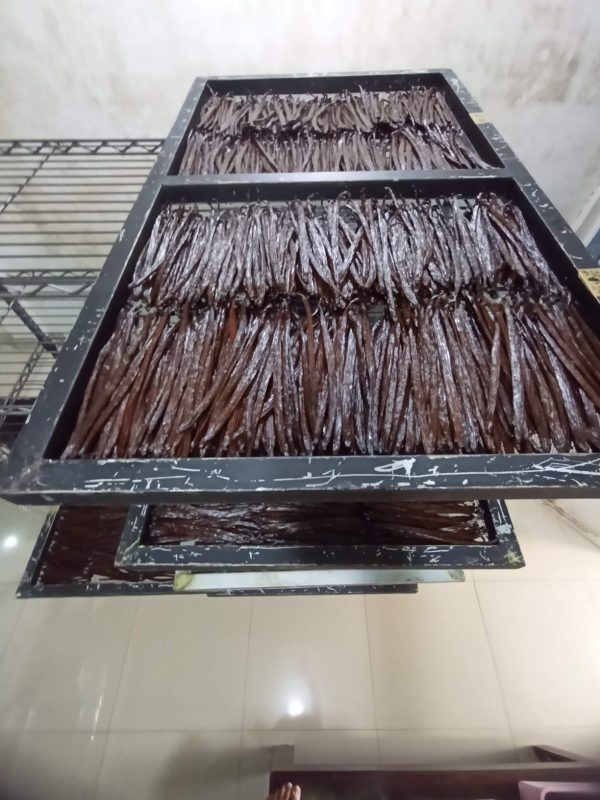
Conditioning boxes at a Vanillature partner farm — beans resting for up to 3 months before quality assessment
The Complete Timeline: 15 Months from Flower to Finished Bean
The full journey of how vanilla beans are made spans approximately 15 months from the moment the orchid flower opens. Each hand-pollination window lasts just 6 to 8 hours — the flower opens from 6am to 9am and closes permanently by afternoon. A missed day means a missed bean.
After successful pollination, the bean grows on the vine for 9 months before reaching harvest maturity. Then the 4-stage curing process adds a further 3 to 6 months. The total time investment per bean is longer than most annual crops take from seed to shelf.
Vanillature sources from 500+ smallholder farmers across Sumatra and Papua who follow this full timeline without shortcuts. Every batch passes a 5-stage quality sorting process before shipping. The 5.0-star average from 174+ verified reviews on eBay reflects that commitment to the complete process — not a single step of it.
Frequently Asked Questions
