


Vanilla Knowledge
Why Real Vanilla Has Tiny Black Specks — And What They Actually Are
Jun
Those tiny black dots scattered through your vanilla ice cream or custard are not impurities, contaminants, or anything to worry about. They are vanilla bean specks in food — the microscopic seeds of the vanilla orchid, each one a concentrated pocket of flavour compounds. A single bean contains between 1,000 and 2,000 of these seeds, and their presence is the most reliable visual signal that real vanilla is in your bowl.
Seeds inside every single vanilla bean pod
Vanillin in Sumatra Planifolia seed oil (industry avg 1.5–2.0%)
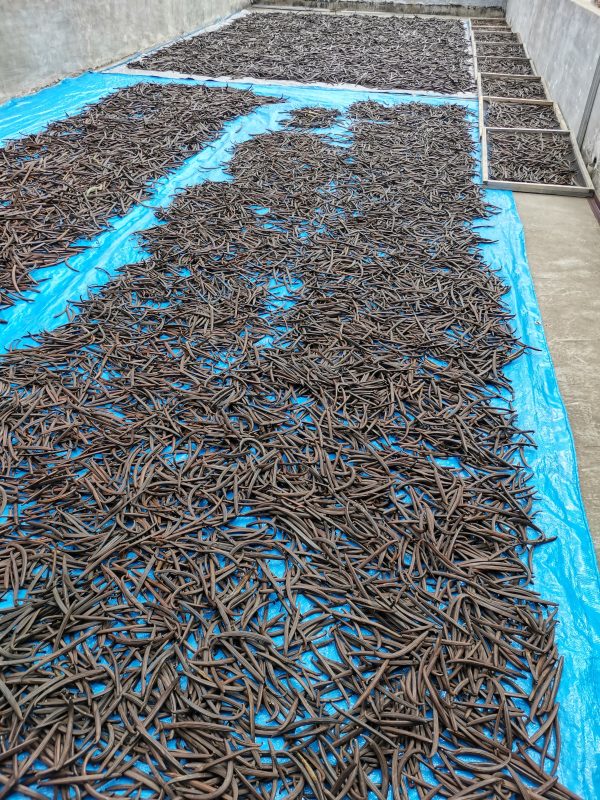
Flower to finished bean — the journey behind every speck
What Vanilla Caviar Actually Is
The interior of a cured vanilla bean holds a dense, sticky paste. That paste is called vanilla caviar — a mixture of the bean’s 1,000 to 2,000 seeds and the oily resin surrounding them. When you scrape a bean with the back of a knife, you release this entire mass at once.
The seeds themselves are tiny, averaging just 0.3 mm in length. They are dark brown to black after curing, which is exactly what creates the visible vanilla bean specks in food. Each seed carries a coating of essential oil rich in vanillin, heliotropin, and more than 200 supporting flavour compounds (Dunphy et al., 2020, Food Chemistry).
This is not decoration. The seed oil accounts for a significant share of a bean’s total flavour load. Removing it — as synthetic vanilla extract does — strips out the textural complexity entirely.
Cross-section of a cured Planifolia bean showing vanilla caviar and seed mass
Image: Vanillature farm documentation, North Sumatra
Why Specks Signal Authenticity — Not Contamination
Synthetic vanilla flavouring contains zero seeds. Vanillin produced from lignin or guaiacol chemistry replicates a single compound at roughly 1.5–2.0% concentration — but it carries none of the 200+ co-occurring molecules found in a real bean.
Vanilla bean specks in food are therefore a direct quality indicator. Their presence confirms that a cook or manufacturer used actual vanilla pods or a genuine seed-bearing extract. Their absence in a product labelled “vanilla flavoured” is a reliable sign that synthetic vanillin was used instead.
Some manufacturers add artificial black specks to vanilla-flavoured products to simulate authenticity. These are typically carob powder or poppy seeds. They carry no vanillin and dissolve or float differently from real seeds when stirred into warm custard.
Quick test: Real vanilla caviar seeds sink slowly and stay suspended in warm cream. They have a faint aromatic note when you rub them between your fingers. Fake specks from carob powder smear and fade immediately.
The Flavour Chemistry Inside Each Seed
Dunphy et al. (2020, Food Chemistry) confirmed that vanilla seeds carry a concentrated profile of flavour-active compounds, including vanillin, p-hydroxybenzaldehyde, and heliotropin. These compounds develop through enzymatic reactions during the 3–6 month curing process after harvest.
At Vanillature, every batch of Sumatra Planifolia tests above 2.5% vanillin — compared to an industry average of 1.5–2.0%. That premium vanillin concentration sits inside both the pod wall and the seed oil. When you scrape a Vanillature bean, you extract both sources simultaneously.
Elevation plays a direct role in this concentration. Our North Sumatra farms sit at 680 metres above sea level. The cooler nights at that altitude slow bean metabolism on the vine and allow a longer, deeper accumulation of flavour precursors across the 9-month maturation period.
“When I cure slowly, I always look at the paste inside. The darker and stickier it is by month 3, the better the final bean. That blackness is the flavour coming out of the seeds — it tells me the curing is working right.”
— Bu Sari, vanilla farmer, Deli Serdang, North Sumatra · 11 years cultivating Planifolia, specialist in slow curing and Crystal Vanilla
How to Scrape a Bean Correctly to Maximise Caviar Yield
Lay the bean flat on a cutting board. Hold it steady with two fingers pressed firmly at one end. Use the spine — the blunt back edge — of a small, sharp knife. Press gently and drag from one end to the other in a single smooth stroke.
You recover roughly 0.5–0.8 g of vanilla caviar from a Grade A Planifolia bean. Grade A beans carry 25–30% moisture, which keeps the seed paste pliable and easy to scrape clean. Grade B beans at 15–25% moisture are drier and release slightly less paste but retain identical vanillin content — they are simply better suited to infusing in liquids.
Do not discard the scraped pod. Split pods steeped in 250 ml of warm cream for 20 minutes release a second wave of vanilla bean specks in food and an additional layer of flavour from the pod wall itself.
Demonstration of caviar scraping technique on a Grade A Planifolia bean
Vanillature kitchen guide — North Sumatra
Crystal Vanilla: The Highest Caviar Density Available
Vanilla bean specks in food reach their visual and flavour peak with Crystal Vanilla — Vanillature’s highest-grade selection. Crystal Vanilla beans are identified during a 5-stage quality sorting process and selected specifically for exceptional seed density and oil content.
These beans display visible crystalline deposits of vanillin on the outer surface — a natural phenomenon called givre or frosting, occurring when vanillin concentration exceeds the pod wall’s capacity to retain it. Every crystal is pure, naturally exuded vanillin. No other grade produces this effect.
Bu Sari, who has specialised in slow curing at our Deli Serdang partner farms for 11 years, oversees the final drying stage of every Crystal Vanilla batch. The 3–6 month curing process she manages is what drives seeds and oils to their maximum concentration before sorting begins.
For pastry chefs, ice cream makers, or home cooks who want every scrape of vanilla caviar to visibly pepper a cream or custard, Crystal Vanilla delivers the densest seed payload available from any Indonesian source.
Crystal Vanilla beans showing givre frosting — naturally exuded vanillin crystals
Vanillature quality selection, Deli Serdang, North Sumatra
Frequently Asked Questions
See Every Speck for Yourself
Our Sumatra Planifolia and Crystal Vanilla beans are sourced from 500+ smallholder farmers and hold a 5.0-star rating across 174+ verified reviews. Every bean is tested, sorted, and ready to scrape.
