


Vanilla Knowledge
How to Tell if Your Vanilla Beans Are Fresh — A Complete Quality Guide
Jul
How to Tell if Your Vanilla Beans Are Fresh — A Complete Quality Guide
Fewer than 30% of vanilla beans sold online meet Grade A standards, yet most listings claim premium quality. Knowing how to check vanilla bean quality — before you open your wallet — separates extraordinary vanilla from a disappointing, flavourless stick. This guide gives you the exact tests to apply.
1. The Touch Test: Supple Beans Bend, Stale Beans Snap
The single fastest way to check vanilla bean quality is a gentle bend test. Hold the bean between both thumbs and slowly arc it into a U-shape. A fresh, properly cured bean flexes smoothly without resistance and returns toward straight when released. A stale or over-dried bean resists, cracks, and often snaps entirely.
This physical behaviour directly reflects moisture content. Grade A beans carry 30–35% moisture — enough to keep the cell walls pliable. Once moisture drops below 15%, the bean becomes brittle and loses the volatile aromatic compounds responsible for its depth of flavour (Dunphy et al., 2020, Food Chemistry).
At Vanillature, every batch passes a 5-stage sorting process that includes a tactile flexibility check on representative beans from each lot. Beans that crack under gentle pressure are downgraded immediately, regardless of their visual appearance.
2. The Scent Test: Complex and Deep, Not Flat or Alcoholic
Open a quality vanilla bean and the aroma should hit you in layers. The first note is warm, sweet vanillin. A secondary note of heliotropin — a naturally occurring aromatic compound — follows within seconds, adding a faint almond and cherry undertone. A third wave of woody, earthy complexity confirms proper enzymatic curing has developed the full flavour profile.
Vanillin concentration drives this experience directly. Fresh Sumatra Planifolia beans from Vanillature test above 2.5% vanillin — compared to the industry average of 1.5–2.0% (Bythrow, 2005, Journal of Food Chemistry). Beans below 1.0% vanillin smell thin and one-dimensional, often with a faint acetone or hay-like odour that signals poor curing.
A sharp alcohol smell indicates the producer used forced or chemical curing rather than the traditional 3–6 month sun-curing process we use across our 500+ smallholder farms in Sumatra. That shortcut strips out the secondary aromatics entirely.
“When I grade a bean, I smell it before I look at it. Fresh beans have three smells — sweet, then a little nutty, then something deep like wood after rain. If I only get one smell, I know something went wrong in the curing.”
— Pak Rudi, vanilla farmer, Tapanuli, North Sumatra — 9 years cultivating Planifolia, specialist in Grade A selection and moisture control
3. The Visual Test: Uniform Dark Brown With a Natural Sheen
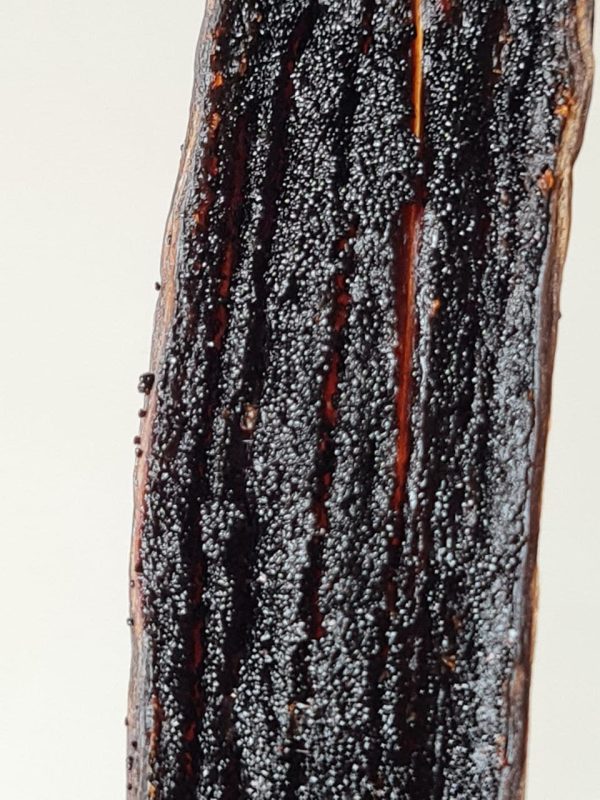
Close-up: Grade A vanilla bean surface showing deep mahogany colour and natural oil sheen
Grade A vanilla beans display a consistent deep mahogany-to-chocolate brown along their full length. The colour runs uniform from tip to stem — patches of green signal under-ripeness, while grey or black blotches indicate mould or bacterial damage during improper storage.
The surface carries a faint, natural oiliness. This sheen comes from vanillin and related aromatic compounds migrating to the outer skin during the sweating and blanching phases of traditional curing. Beans that look chalky or matte have lost this oil layer, usually through excessive heat drying. Beans must reach a minimum of 15 cm in length to earn Grade A classification — shorter beans contain a lower seed-to-hull ratio and therefore less concentrated flavour.
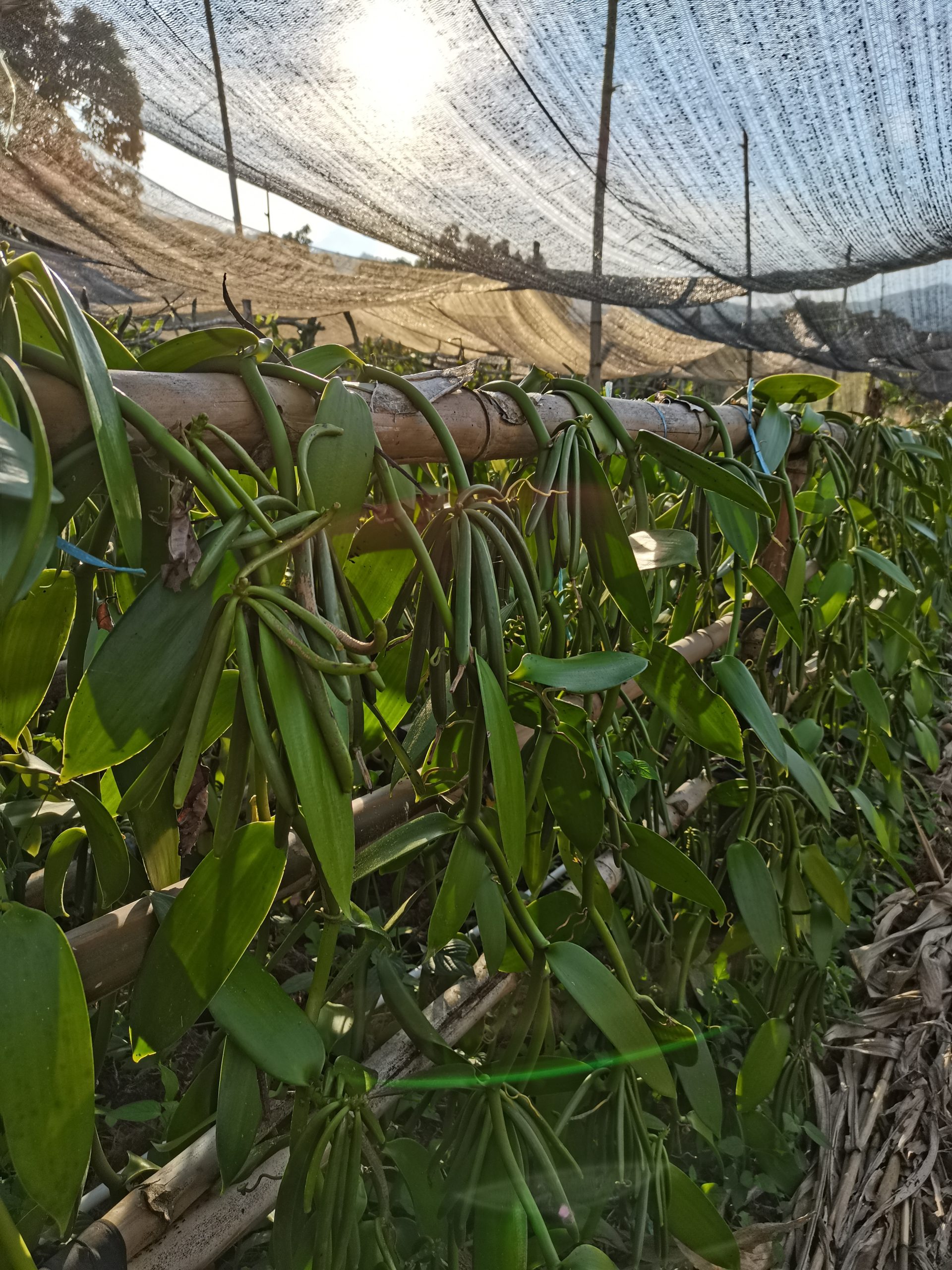
At Vanillature, our farms sit at 680 metres above sea level in North Sumatra. This elevation slows the bean’s maturation over 9 months on the vine, producing a denser, more aromatic pod with a naturally higher oil content and that characteristic sheen visible on every Grade A bean we ship.
4. Red Flags: Mould, Crystallised Sugar, and Hollow Pods
Mould appears as white or grey fuzzy patches on the bean surface, not as the fine white crystals that indicate high vanillin. Learning to distinguish the two is one of the most important skills in assessing vanilla bean quality. Vanillin crystals — called givre in the trade — are hard, flat, and catch light with a slight sparkle. Mould is soft, powdery, and lacks any iridescence.
White crystalline deposits that feel sticky rather than dry signal crystallised sugars — a sign the beans were stored in a warm, humid environment without proper air circulation. This is different from desirable vanillin crystallisation. Sugar crystallisation happens when glucose in the bean caramelises and migrates outward, a process that simultaneously degrades the aromatic compounds inside.
Hollow or flat pods indicate the beans were harvested before the 9-month on-vine maturation period completed. An immature bean has a thin wall, minimal seed cavity, and lower vanillin content — often below 1.0%. Squeeze the bean gently between two fingers: a quality Grade A bean feels solid and plump along at least 75% of its length.
5. Understanding Grade A vs Grade B — And What Each Is For
Infographic: Grade A vs Grade B vanilla bean specification comparison chart
Grade A beans — also called gourmet or prime beans — carry 30–35% moisture and vanillin above 2.0%. They are the correct choice for any recipe where the bean itself is visible: crème brûlée, ice cream, custard, or infused sugar. The caviar (seeds) scrape out cleanly and the pod steeps with full aromatic impact.
Grade B beans carry 15–25% moisture and vanillin above 1.0%. They are drier, slightly less visually uniform, and ideal for extraction, powder production, or long infusions where the pod dissolves into a liquid medium. Grade B beans are not inferior — they are purpose-specific. Buying Grade B for direct culinary use, however, produces noticeably weaker flavour results.
Indonesia produces approximately 2,300 tonnes of vanilla annually — the second-largest volume globally after Madagascar (FAO, Food and Agriculture Organization of the United Nations). Knowing how to check vanilla bean quality within that volume helps buyers source reliably rather than relying solely on country-of-origin labelling.
Frequently Asked Questions: Vanilla Bean Quality
Shop Vanilla Beans That Pass Every Quality Test
Every Vanillature bean passes our 5-stage sorting process — checked for moisture, length, flexibility, aroma, and vanillin content before it ships. Grade A and Grade B options available for both culinary and extraction use.
Vanillature holds a 5.0 star rating from 174+ verified buyers on eBay, with additional verified ratings on Shopee and TikTok Shop Indonesia — independently confirmed quality across three separate platforms.
Vanillature (PT. Sumber Bukit Jaya) — Jl. Prof. H.M. Yamin SH No. 224M, Medan, North Sumatra 20234, Indonesia — +62 878-6986-1288
