


Vanilla Knowledge
Indonesia vs Madagascar: Why the World’s #2 Vanilla Producer Is the Baker’s Best-Kept Secret
Aug
Indonesia vs Madagascar: Why the World’s #2 Vanilla Producer Is the Baker’s Best-Kept Secret
A pastry chef in Kuala Lumpur spent three years loyal to a single Madagascar supplier. Then a colleague slipped a small batch of Sumatran beans into her prep kitchen. She ran the same crème brûlée recipe side by side — same custard ratio, same temperature, same torch. The Sumatra version was richer, louder, more complex. She tested the vanillin content afterward: the Indonesian vanilla beans she had just used measured above 2.5%, compared to the 1.5–2.0% industry average she had accepted as the benchmark. That was the switch she never reversed.
Vanillin content in Sumatra Planifolia
(industry avg 1.5–2.0%)
Indonesia annual production — #2 globally after Madagascar
Elevation of North Sumatra farms — slow ripening, dense beans
The Numbers Behind Indonesia’s Vanilla Industry
Indonesia produces approximately 2,300 tonnes of vanilla annually, making it the world’s second-largest producer after Madagascar (FAO Crop Statistics, 2023). Most bakers have never encountered this volume directly — because most of it moves quietly into food manufacturing and flavour extract production at scale.
That industrial pipeline has kept Indonesian vanilla beans largely invisible to artisan buyers. The volume is there. The quality, at smallholder farm level, frequently exceeds what reaches the premium retail market from other origins. At Vanillature, we source directly from 500+ smallholder farmers across Sumatra and Papua, bypassing the commodity chain entirely.
The result: beans that test at vanillin levels the mainstream market rarely sees.
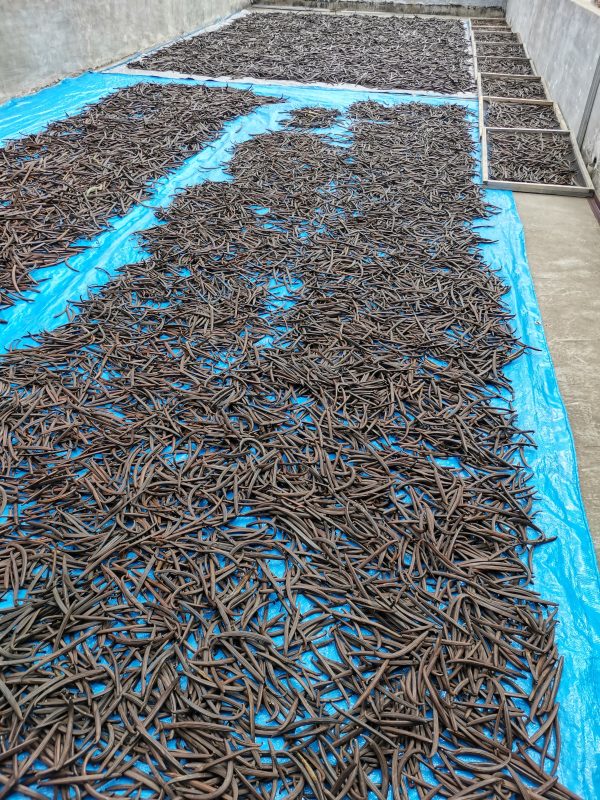
Traditional sun-curing of Planifolia beans, North Sumatra highlands — 680 m elevation
Vanillin Content — The Chemistry That Separates Origins
Vanillin (4-hydroxy-3-methoxybenzaldehyde) is the primary aromatic compound responsible for vanilla’s signature flavour. Research by Bythrow (2005) in the Journal of Food Chemistry establishes that vanillin concentration directly correlates with perceived flavour intensity in baked applications.
Most commercial vanilla beans — including many Madagascar exports — test between 1.5% and 2.0% vanillin by dry weight (Dunphy et al., 2020, Food Chemistry). Sumatra Planifolia beans from Vanillature’s farm network consistently test above 2.5%. Our Crystal Vanilla — the beans where vanillin crystals have visibly formed on the surface — reaches 3.5–4%, the highest concentration in our range.
Those surface crystals are not a flaw or mould. They are concentrated vanillin. The crystal formation confirms enzymatic curing has proceeded fully and correctly across the 3–6 month slow-cure period.
| Attribute | Sumatra Planifolia (Vanillature) | Madagascar Planifolia (Industry Avg) |
|---|---|---|
| Vanillin content | 2.5%+ (Crystal: 3.5–4%) | 1.5–2.0% |
| Elevation | 680 m above sea level | Sea level to 300 m (most growing regions) |
| Curing method | Traditional sun curing, 3–6 months | Varies; often accelerated |
| Flower to finished bean | ~15 months total | ~12–15 months |
| Grade A moisture | 30–35%, vanillin above 2.0% | 30–35% (quality varies by lot) |
| Annual country output | ~2,300 tonnes (#2 globally) | ~2,500–3,000 tonnes (#1 globally) |
What 680 Metres Does to a Vanilla Bean
Elevation slows everything — and in vanilla cultivation, slow is flavour. At 680 metres above sea level in North Sumatra, temperature swings between day and night are wider than in lowland growing zones. Bean cells develop more slowly over the 9-month maturation window on the vine.
That extended cellular development concentrates glucovanillin precursors within the bean’s tissue. During enzymatic curing — the blanching, sweating, and slow sun-drying sequence described by Havkin-Frenkel & Belanger (2011) — those precursors convert to vanillin at higher final concentrations than lowland-grown beans of the same variety.
Terroir in vanilla is real, and measurable. The 680-metre farms in our Sumatra network produce beans with a profile that combines deep, woody vanilla base notes with secondary layers of tobacco and dried fruit — distinct from the creamier, simpler profile typical of lower-altitude origins.
“The altitude here means our beans take longer to ripen, but that extra time on the vine is everything. When I harvest a bean after 9 months and it feels heavy in my hand, I know the flavour is already inside — the curing just unlocks it.”
— Pak Irwan, vanilla farmer, Simalungun, North Sumatra, 12 years cultivating Planifolia
Why Most Bakers Have Never Tasted Indonesian Vanilla Beans
Of Indonesia’s 2,300 tonnes of annual vanilla production, the majority flows directly to large-scale extractors in the US, EU, and Japan. Those buyers purchase at commodity grade and blend across origins. The Indonesian component disappears into extract bottles labelled without country identification.
Artisan buyers who search for single-origin vanilla beans typically default to Madagascar — because Madagascar has spent 30 years building brand recognition in the premium segment. Indonesia has not. That gap is a buyer’s opportunity right now.
At Vanillature, every batch passes through a 5-stage quality sorting process before dispatch. We test moisture and vanillin on representative samples from each harvest. Grade A beans meet 30–35% moisture and vanillin above 2.0%. Grade B beans carry 15–25% moisture and vanillin above 1.0% — optimal for grinding and extract work. Nothing ships below those thresholds.
5-stage quality sorting at Vanillature — moisture testing and vanillin verification before every dispatch
The Flavour Profile — What to Expect in the Kitchen
Indonesian Planifolia delivers a bold, full-spectrum vanilla profile. The dominant character is deep, almost smoky vanilla — driven by that 2.5%+ vanillin concentration — with secondary notes of dark wood, leather, and dried stone fruit emerging in heat applications.
In cold applications — ice cream bases, raw ganache, no-bake cheesecake — the floral-woody complexity reads more clearly than in cooked preparations. At baking temperatures above 180°C, the intensity amplifies. A single bean per litre of custard is sufficient; Madagascar recipes calling for 2 beans often need only 1 when Sumatra Planifolia replaces them.
For bakers who want a softer, more floral profile, our Papua Tahitian variety (Vanilla tahitensis) from Bu Marlina’s growing region offers heliotropin-forward notes with lower vanillin content. The two varieties solve different flavour briefs. Sumatra solves for intensity; Papua solves for delicacy.
Frequently Asked Questions
Indonesian Planifolia from high-elevation Sumatra farms consistently tests above 2.5% vanillin content, compared to the 1.5–2.0% industry average that includes most Madagascar exports. By the primary quality metric for vanilla — vanillin concentration — premium Indonesian vanilla beans outperform the global average. Indonesia is the world’s second-largest producer at approximately 2,300 tonnes annually (FAO Crop Statistics, 2023), but most of that volume enters commodity extract production, keeping it unknown to artisan buyers.
A vanillin content of 2.0% or above qualifies as Grade A by international standards. The industry average across commercial vanilla beans sits at 1.5–2.0% (Dunphy et al., 2020, Food Chemistry). Vanillature’s Sumatra Planifolia tests above 2.5%, and Crystal Vanilla — beans with visible surface crystals of concentrated vanillin — reaches 3.5–4%, the highest concentration in our product range. Moisture content matters equally: Grade A beans carry 30–35% moisture, which preserves extractable aromatics.
Indonesia produces approximately 2,300 tonnes of vanilla annually, ranking second globally after Madagascar (FAO Crop Statistics, 2023). Despite this volume, Indonesian vanilla beans remain underrepresented in the premium artisan market because the majority of production is absorbed by large-scale commercial extract manufacturers who blend across origins. Direct-trade suppliers like Vanillature, sourcing from 500+ smallholder farmers, make single-origin Indonesian vanilla accessible to bakers and chefs at retail scale.
At 680 metres above sea level, North Sumatra’s diurnal temperature variation slows bean maturation across the 9-month growing period on the vine. Slower cellular development concentrates glucovanillin precursors — the compounds that convert to vanillin during enzymatic curing. The 3–6 month traditional sun-curing process then unlocks those precursors more fully than in beans grown at lower elevations with shorter maturation windows (Havkin-Frenkel & Belanger, 2011). The result is the 2.5%+ vanillin content that defines Vanillature’s Sumatra Planifolia range.
Try the Beans That Changed One Chef’s Kitchen
Vanillature sources direct from 500+ smallholder farmers in Sumatra and Papua. Every batch is tested, graded, and dispatched with verified vanillin data. Grade A and Crystal Vanilla available now.
Vanillature holds a 5.0 star rating from 174+ verified buyers on eBay, with additional verified ratings on Shopee and TikTok Shop Indonesia — independently confirmed quality across three separate platforms.
Vanillature (PT. Sumber Bukit Jaya) — Jl. Prof. H.M. Yamin SH No. 224M, Medan, North Sumatra 20234, Indonesia — +62 878-6986-1288