


Vanilla Knowledge
Why Does Real Vanilla Extract Turn Dark Brown?

Aug
That deep mahogany colour in your bottle of pure vanilla extract is not a defect. It is chemistry working exactly as it should. Real vanilla beans contain more than 200 distinct flavour compounds — compared to the single synthetic molecule (vanillin only) found in artificial vanilla. The darkness is the visual proof of those compounds dissolving into solution. If your vanilla extract is clear or pale yellow, it almost certainly is not real.
Flavour compounds in real vanilla extract vs 1 in artificial
Minimum alcohol base required for true vanilla extraction
Minimum infusion time for full compound extraction
The Chemistry Behind Pure Vanilla Extract Colour
Vanilla beans are extraordinarily complex botanical structures. A single Grade A Vanillature Sumatra Planifolia bean contains well over 200 flavour-active compounds, including vanillin, heliotropin, p-hydroxybenzaldehyde, and numerous phenolic acids (Dunphy et al., 2020, Food Chemistry). These phenolic compounds are deeply pigmented by nature — the same class of molecules that colours red wine, aged whisky, and dark tea.
When beans are submerged in a 40% alcohol base, the ethanol acts as a solvent, pulling those pigmented phenolics out of the bean tissue and into suspension. Over 8–12 weeks of minimum infusion time, the liquid deepens from pale gold to rich amber, and then to the characteristic dark brown of a properly made extract. The darker the extract, the more phenolics have been extracted — and phenolics carry flavour.
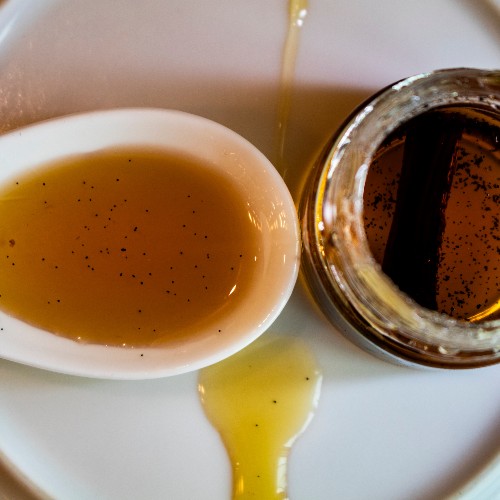
Vanillin itself — the primary aromatic compound — is colourless in pure form. The brown colour comes predominantly from vanillic acid, protocatechuic acid, and other co-extracted phenolics. This is why pure vanilla extract colour deepens with concentration: more phenolics, more colour, more complexity of flavour.
What Clear Vanilla Extract Actually Tells You
Artificial vanilla extract contains exactly 1 compound: synthetic vanillin, produced industrially from lignin or guaiacol. Synthetic vanillin is colourless. Manufacturers dissolve it in water or a low-alcohol carrier, and the resulting liquid stays clear or faintly yellow because there are no phenolic pigments present.
Some producers add caramel colouring to artificial vanilla to mimic the darkness of genuine extract. A simple test separates them: shake the bottle. Caramel-coloured artificial vanilla produces a uniform, slightly syrupy look. Real extract at 40% alcohol produces a thinner, water-like movement with visible depth. At Vanillature, we test every batch with a refractometer to confirm alcohol content and vanillin concentration before dispatch.
Labelling law in many markets requires products sold as “pure vanilla extract” to contain a minimum of 35% alcohol and at least 100g of vanilla beans per litre. Products labelled “vanilla flavour” or “vanilla essence” carry no such requirement. Pure vanilla extract colour — deep, translucent brown — is the fastest visual indicator that minimum legal and quality standards have actually been met.
How Vanillature Beans Produce Exceptional Extract Colour and Depth
The raw material determines the final extract quality. Vanillature sources Planifolia beans from 500+ smallholder farmers in North Sumatra, cultivated at 680 metres above sea level. At that elevation, cooler nights slow the bean’s metabolism, allowing vanillin glucosides and phenolic precursors to accumulate over the full 9-month maturation period on the vine.
After harvest, the curing process — which runs 3–6 months using traditional sun-curing methods — converts those precursors into active vanillin and associated phenolics through enzymatic action. Properly cured Vanillature Planifolia tests consistently above 2.5% vanillin content, compared to the industry average of 1.5–2.0%. Higher vanillin and phenolic density translates directly into a darker, richer pure vanilla extract colour when the beans are infused.
“When I see a batch of beans with good moisture — 30 to 35 percent — and the skin has that oily sheen, I know the extract from those beans will be very dark. Light-coloured extract always comes from beans that were rushed. You cannot rush the sweating stage — it is where the colour is built.”
— Pak Rudi, vanilla farmer, Tapanuli, North Sumatra, 9 years cultivating Planifolia
For our Crystal Vanilla beans — which carry surface vanillin crystals visible to the naked eye — vanillin content reaches 3.5–4%, the highest in our range. Infusing Crystal Vanilla beans produces an extract of exceptional depth and pure vanilla extract colour that turns near-black at full concentration. That surface crystallisation is concentrated vanillin, not mould or spoilage.
Storage Rules That Protect Extract Colour and Flavour
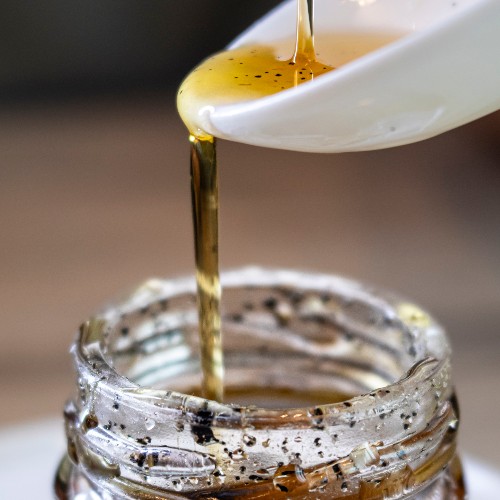
Pure vanilla extract colour can shift — and flavour degrade — through improper storage. Three conditions cause the most damage: heat above 25°C, direct sunlight, and repeated oxygen exposure. Heat accelerates the oxidation of phenolic compounds, turning a rich brown extract cloudy and dull. UV light breaks down vanillin molecules directly, reducing aroma within 4–6 weeks of sun exposure.
Store extract in dark glass — amber or cobalt — at room temperature between 15–22°C. Keep the cap sealed between uses. A properly stored real vanilla extract at 40% alcohol is shelf-stable for 5 years or more; the alcohol functions as a preservative. Refrigeration is unnecessary and can cause harmless but unsightly precipitation of vanilla solids, which customers sometimes mistake for spoilage.
Never purchase pure vanilla extract in clear glass or plastic bottles. Both allow light penetration that degrades phenolics over 8–12 weeks — precisely the infusion period required to build full compound extraction. The packaging signals whether a producer understands the chemistry of what they are selling.
Making Your Own Extract: Getting the Colour Right
Home extraction requires a 40% minimum alcohol base — a 80-proof (40% ABV) vodka is the standard starting point. Lower alcohol concentrations (below 35%) fail to extract the full range of phenolic compounds, producing pale, thin extracts with limited flavour complexity. Use 100g of Grade A vanilla beans per 1 litre of alcohol to meet commercial-grade standards.
Allow a minimum of 8–12 weeks infusion time before first use, shaking once weekly. At the 4-week mark, the liquid will appear amber. At 8 weeks, it deepens noticeably. By 12 weeks, a correct pure vanilla extract colour — deep mahogany brown — confirms full phenolic extraction. Straining the beans at this point is optional; leaving them in the liquid produces a stronger extract that continues to develop for up to 12 months.
Vanillature Grade A Sumatra beans carry 30–35% moisture and vanillin above 2.0% — both critical for home extraction. Dry beans (below 15% moisture) release phenolics more slowly and produce lighter extracts over the same infusion period. Moisture in a cured bean is the delivery mechanism for flavour compounds into solution.
Frequently Asked Questions
Yes — dark colour confirms quality, not spoilage. Real vanilla extract turns dark brown because it contains more than 200 phenolic compounds extracted from the bean. These pigmented molecules are flavour-active and completely safe. A properly stored extract at 40% alcohol is shelf-stable for 5+ years. Darkness intensifies as phenolics continue to extract from the bean material — it is a sign the product is working correctly (Dunphy et al., 2020, Food Chemistry).
Clear vanilla extract almost certainly contains no real vanilla. Artificial vanilla uses exactly 1 compound — synthetic vanillin — which is colourless in solution. Genuine vanilla extract derives its deep brown colour from the 200+ phenolic pigments that dissolve during an 8–12 week minimum infusion in a 40% alcohol base. A clear product lacks those phenolics and therefore lacks the flavour complexity, aromatic depth, and health-associated antioxidant activity of genuine extract.
Real vanilla extract reaches its characteristic dark brown colour after 8–12 weeks of infusion at a minimum 40% alcohol concentration. At 4 weeks, the liquid turns amber as initial vanillin and light phenolics extract. By 8 weeks, deeper pigmented compounds enter solution. Full extraction — and full colour development — completes between 8 and 12 weeks. Using Grade A beans with 30–35% moisture and vanillin above 2.0% accelerates this timeline compared to low-quality dry beans.
A 40% alcohol base (80-proof spirit) produces the optimal balance of phenolic extraction and flavour. Below 35%, the solvent is too weak to extract the full range of 200+ compounds, resulting in pale, thin extract with limited complexity. Above 60%, the alcohol becomes too aggressive and extracts harsher compounds, overwhelming the delicate floral notes. Commercial pure vanilla extract is legally required in most markets to contain a minimum of 35% alcohol — the 40% sweet spot maximises colour depth and flavour extraction simultaneously.
Experience Extract-Quality Vanilla Beans from Sumatra
Vanillature Grade A Planifolia beans — 30–35% moisture, vanillin above 2.0% — are the raw material behind deep, phenolic-rich pure vanilla extract colour. Sourced from 500+ smallholder farmers. Tested at every stage.
Vanillature holds a 5.0 star rating from 174+ verified buyers on eBay, with additional verified ratings on Shopee and TikTok Shop Indonesia — independently confirmed quality across three separate platforms.
Vanillature (PT. Sumber Bukit Jaya) — Jl. Prof. H.M. Yamin SH No. 224M, Medan, North Sumatra 20234, Indonesia — +62 878-6986-1288
