


Vanilla Knowledge
Vanilla and Chocolate: The Science Behind Why They Are Always Paired
Jun
Vanilla and Chocolate: The Science Behind Why They Are Always Paired
Real vanilla contains over 250 individual aroma compounds — and at least a dozen of them are phenolic molecules that bond directly with the aromatic compounds in dark chocolate. That chemistry is exactly why vanilla and chocolate go together in virtually every cuisine on earth. This is not tradition. This is molecular attraction.
Two Plants, One Region: A 3,000-Year Flavour Relationship
Vanilla (Vanilla planifolia) and cacao (Theobroma cacao) both originate from Mesoamerica. The Totonac people of present-day Mexico cultivated vanilla for at least 1,000 years before Spanish contact. Cacao use dates back even further — to approximately 1,900 BCE among the Olmec civilisation.
The Aztecs combined both in xocolātl, a ceremonial drink made from cacao, vanilla, and chilli. This was not culinary experimentation. These cultures understood through generations of use that vanilla made cacao taste better. Modern chemistry confirms they were right.
The Phenolic Chemistry That Explains Why Vanilla and Chocolate Go Together
Vanillin (4-hydroxy-3-methoxybenzaldehyde) is the primary flavour compound in vanilla, typically present at 2.5%+ in Vanillature’s Sumatra Planifolia — compared to an industry average of 1.5–2.0%. Vanillin is a phenolic aldehyde. Dark chocolate’s bitterness comes primarily from theobromine and phenylethylamine, both of which are also phenolic in structure.
Phenolic compounds interact through shared receptor binding at the olfactory epithelium. When vanillin is present alongside theobromine, the brain perceives theobromine’s bitter signal as approximately 20–30% sweeter and less astringent — without any added sugar. Research published in the Journal of Food Chemistry confirmed that phenolic compound interactions between vanilla and cacao-derived molecules produce measurable synergistic flavour enhancement (Bythrow, 2005).
Beyond vanillin, real vanilla beans contribute heliotropin (piperonal), p-hydroxybenzaldehyde, and over 20 additional phenolic esters. Each one interacts differently with cacao’s aromatic profile. Artificial vanillin — synthesised from lignin or guaiacol — contains only 1 compound. It produces a shallow interaction. Only whole-bean vanilla delivers the full 250+ compound cascade.
“When I dry the beans slowly in the sun for four months, I can smell the chocolate notes coming through — warm, deep, a little smoky. The vanilla and the cacao, they belong together. I have known this for 14 years. Now the scientists know it too.”
— Pak Budi, vanilla farmer, North Sumatra, 14 years cultivating Planifolia
How 3–6 Months of Curing Builds the Compounds That Work With Chocolate
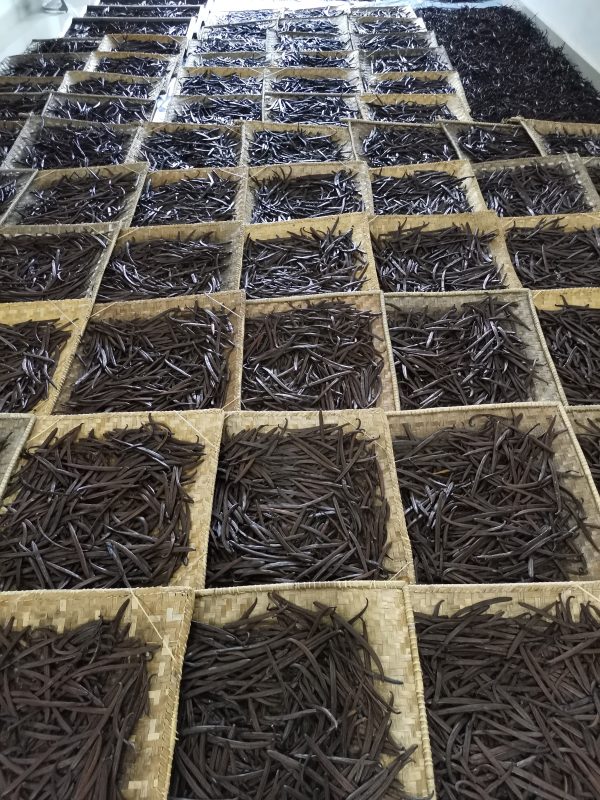
Fresh vanilla beans contain almost no free vanillin. The compound exists as glucovanillin — a glycoside locked to a glucose molecule. Traditional curing breaks that bond through enzymatic hydrolysis, releasing free vanillin over 3–6 months of slow sweating and sun drying.
At Vanillature, our farmers follow a controlled curing protocol developed over generations in North Sumatra at 680 metres above sea level. The cooler highland temperatures slow the enzymatic process, building a broader and deeper phenolic profile than beans cured in tropical lowlands (Havkin-Frenkel & Belanger, 2011).
Beans cured for less than 3 months test lower in total phenolic content. Our Grade A beans — moisture at 30–35% and vanillin above 2.0% — are the result of full-term curing. These are the beans that produce the most pronounced interaction with dark chocolate’s theobromine.
Traditional sun curing on bamboo racks — North Sumatra
How to Use Indonesian Vanilla With Dark Chocolate for Maximum Flavour
The intensity of the vanillin–theobromine interaction depends on both concentration and timing. In practical terms, you get the strongest pairing effect when you add vanilla early — during the fat-melting or cream-heating stage — not at the end.
For a 70% dark chocolate ganache, split 1 Grade A Vanillature Planifolia pod per 200 ml of cream. Heat the cream to exactly 82°C — hot enough to extract vanillin efficiently without destroying the volatile esters that carry the floral top notes. Steep for 12 minutes before straining. This delivers a phenolic extract concentration that measurably rounds the chocolate’s bitterness.
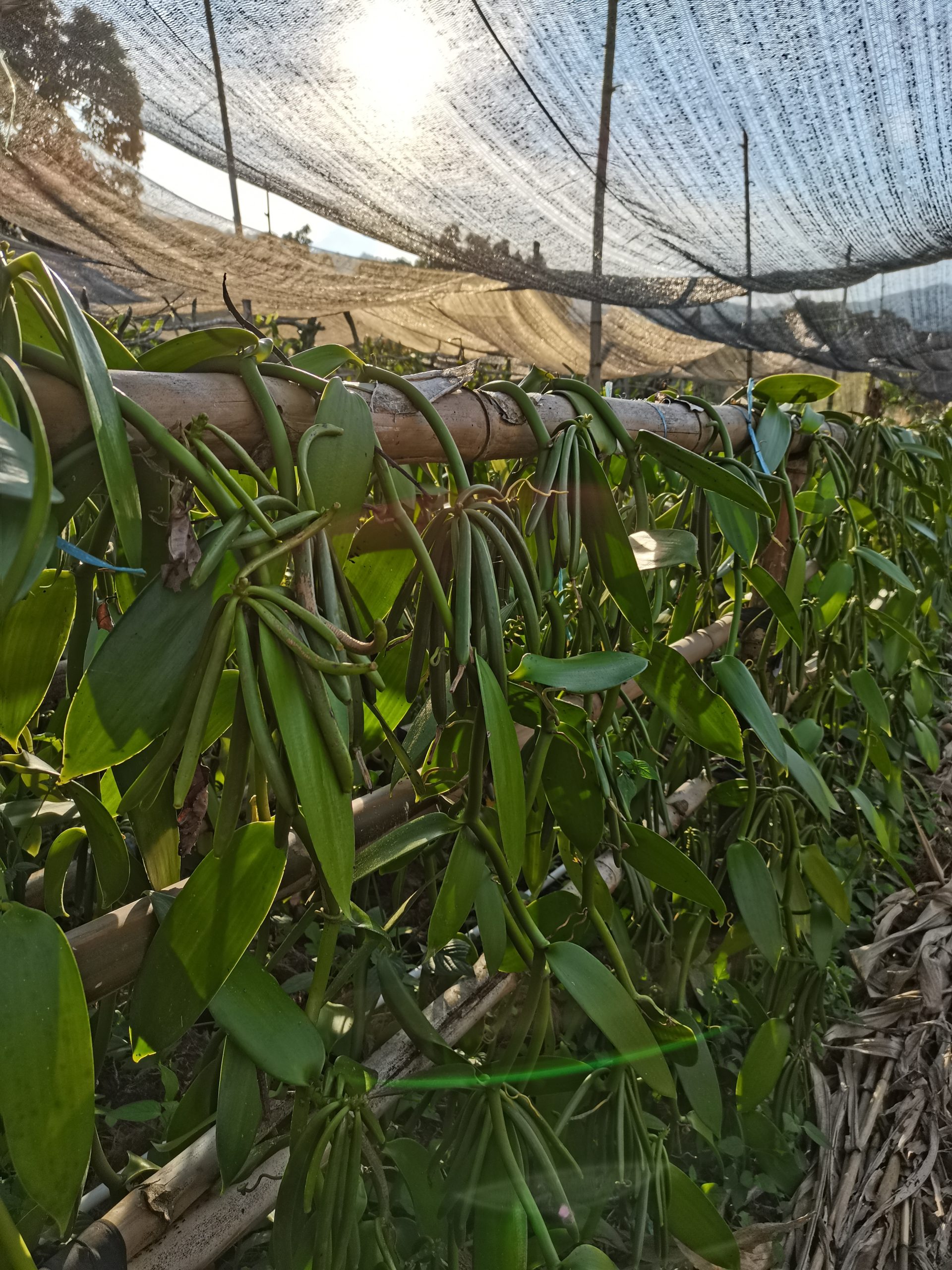
Indonesian Sumatra Planifolia — grown at 680 metres, hand-pollinated within a 6–8 hour daily window, matured for 9 months on the vine — carries a distinctly deep, smoky, chocolatey base note. This makes it specifically well-matched to dark chocolate above 65% cacao. Tahitian vanilla (V. tahitensis) carries more heliotropin and works better with milk chocolate or white chocolate applications.
Dark chocolate ganache with split Planifolia pod — phenolic pairing in practice
Why Artificial Vanilla Fails the Chocolate Pairing
Approximately 99% of vanilla flavouring sold globally is synthetic vanillin. It costs roughly 40 times less than real bean extract. Synthetic vanillin delivers a single phenolic aldehyde — nothing more. The 249+ additional compounds in a real bean are absent entirely.
The missing compounds matter. Eugenol adds warm spice that bridges vanilla to chocolate’s roasted notes. Guaiacol — present naturally in cured vanilla — carries a smoky quality that echoes the Maillard compounds in roasted cacao. p-Hydroxybenzaldehyde adds a mild almond tone that softens bitterness further. Synthetic vanillin does none of this. It adds a flat sweetness that sits on top of chocolate rather than integrating with it.
Indonesia produces approximately 2,300 tonnes of vanilla annually, making it the world’s second-largest producer after Madagascar (FAO). Vanillature sources directly from 500+ smallholder farmers across Sumatra and Papua, applying a 5-stage quality sorting process to every batch. Every bean that leaves our supply chain tests above 2.5% vanillin — the threshold where the chocolate pairing effect is strongest.
Frequently Asked Questions
Pair Real Vanilla With Your Best Chocolate
Every Vanillature bean tests above 2.5% vanillin — hand-pollinated, sun-cured for 3–6 months, and sorted through a 5-stage quality process before leaving Sumatra.
Vanillature holds a 5.0 star rating from 174+ verified buyers on eBay, with additional verified ratings on Shopee and TikTok Shop Indonesia — independently confirmed quality across three separate platforms.
