


Vanilla Knowledge
What Is Double Strength Vanilla Extract — And Do You Need It?
Jun
What Is Double Strength Vanilla Extract — And Do You Need It?
The FDA defines standard vanilla extract as containing 13.35 oz of vanilla beans per gallon of 40% ABV spirit — and double strength extract simply doubles that to 26.7 oz per gallon (FDA Code of Federal Regulations 21 CFR 169.175). More beans means more vanillin per drop. But whether you actually need it depends entirely on one variable: the vanillin content of the beans used to make your extract in the first place.
Beans per gallon in double strength extract — exactly 2× the FDA standard ratio
Vanillin in Vanillature Sumatra Planifolia — vs. 1.5–2.0% industry average
Minimum alcohol base required by FDA to legally call a product vanilla extract
What the Regulations Actually Say About Double Strength
Under FDA 21 CFR 169.175, a single-fold vanilla extract must be made with a minimum of 13.35 oz of vanilla beans per gallon of 40% ABV base spirit. Double strength — sometimes labelled “2× fold” or “double-fold” — contains exactly 26.7 oz per gallon. The regulation sets no upper limit on fold strength, so you will also find 3× and 4× products marketed to industrial food manufacturers.
The fold system was designed for commercial scaleability. When a factory produces 50,000 litres of ice cream and needs to keep flavour consistent batch after batch, using a concentrated extract reduces the volume of liquid added to each vat. Precision is easier at scale with a denser product. For a home baker making 2 dozen cookies, the advantage simply does not exist at the same level.
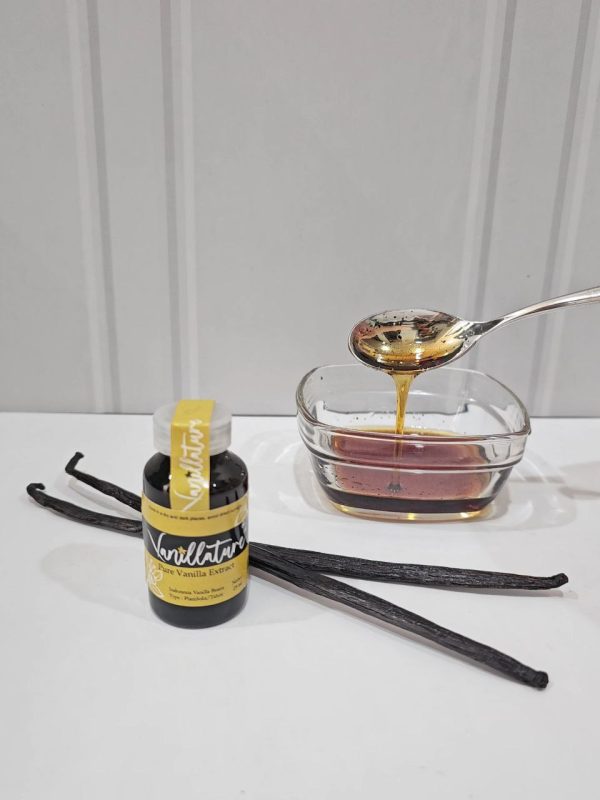
Vanilla extract bottles — single fold vs double strength comparison
Standard extract (13.35 oz/gallon) alongside double strength extract (26.7 oz/gallon) — the fold system explained visually.
Why Bean Quality Changes the Equation Completely
Here is the part most vanilla marketing ignores. Not all vanilla beans carry the same vanillin concentration. Commodity-grade beans — the ones used in most mass-produced extracts — average between 1.5% and 2.0% vanillin by dry weight (Dunphy et al., 2020). A double strength extract made from those beans delivers roughly 3.0–4.0% vanillin equivalent per drop.
Vanillature’s Sumatra Planifolia beans consistently test above 2.5% vanillin — already 25–66% higher than the commodity average. A standard single-fold extract built on these beans can match or outperform many commercial double strength products made from lower-quality stock. You get the flavour intensity without doubling the bean-to-liquid ratio or the price per bottle.
Bean vanillin concentration is shaped by elevation, curing method, and harvest timing. Our North Sumatra farms sit at 680 metres above sea level, where cooler temperatures slow the growing cycle and encourage deeper flavour compounds. Beans mature on the vine for 9 months before harvest, then undergo 3–6 months of traditional sun curing — a 15-month total production cycle from flower to finished bean. That duration concentrates the aromatic compounds that make the extract potent at single-fold strength.
“When I hand-pollinate, I work fast — each flower is only open for 6 to 8 hours. If you miss that window, there is no bean, no extract, nothing. That is why we take every stage seriously. The flavour you taste in the bottle started with one careful morning in the garden.”
— Pak Budi, vanilla farmer, North Sumatra, 14 years cultivating Planifolia
When Double Strength Extract Is Actually Justified
Commercial bakeries and food manufacturers processing hundreds of kilograms of dough per day have legitimate reasons to use double strength vanilla extract. Using a 2× concentrate means adding half the liquid volume to achieve the same flavour — a real benefit when liquid ratios affect dough hydration or emulsion stability in industrial mixing equipment.
High-heat applications are a second valid use case. Baking at 180°C+ volatilises lighter aromatic compounds first. A double strength extract simply starts with more aromatic mass, so more survives the oven. However, this argument applies equally to starting with a single-fold extract made from high-vanillin beans — the math works the same way.
Large-scale commercial baking facility — industrial vanilla extract usage context
Industrial food production — one of the few contexts where double strength extract provides a measurable practical advantage.
For Home Bakers: The High-Vanillin Single Fold Is Smarter
Most home baking recipes call for 1 to 2 teaspoons of vanilla extract. At that volume, the difference between a standard-fold and double-fold extract is approximately 1 teaspoon. The flavour impact of that extra teaspoon is real — but so is the price difference. Double strength extract typically costs 60–90% more per millilitre than single-fold from the same brand.
The better strategy is to start with a single-fold extract built on premium, high-vanillin beans. Indonesia produces approximately 2,300 tonnes of vanilla annually, making it the world’s second-largest producer after Madagascar (FAO). Within that total, Sumatra Planifolia from smallholder farms at elevation represents a distinct quality tier — and that quality shows directly in vanillin readings.
- Commodity single-fold extract: 1.5–2.0% vanillin in beans → moderate flavour intensity
- Commodity double strength extract: 3.0–4.0% vanillin equivalent → higher intensity, higher cost
- Vanillature single-fold (Sumatra Planifolia): 2.5%+ vanillin in beans → competes directly with commodity double strength
- Vanillature Crystal Vanilla beans: 3.5–4% vanillin — surface crystals are concentrated vanillin — highest in our entire range
How Vanillature Sources and Quality-Controls Every Batch
At Vanillature, we source from 500+ smallholder farmers across North Sumatra and Papua, each operating small family plots where hand-pollination is done individually during the 6–8 hour daily window when Planifolia flowers are open. There are no large mechanical operations cutting corners on timing or curing duration.
Every batch passes a 5-stage quality sorting process before grading. Grade A beans carry 30–35% moisture and vanillin above 2.0%. Grade B beans carry 15–25% moisture and vanillin above 1.0%. Both grades are traceable to specific farms. When you use our extract or beans at home, you start with raw material that already outperforms the commodity baseline — making the case for double strength unnecessary for most applications.
Frequently Asked Questions
Double strength vanilla extract contains exactly 26.7 oz of vanilla beans per gallon of 40% ABV spirit — precisely twice the 13.35 oz minimum required for single-fold extract under FDA 21 CFR 169.175. The regulation governs both the bean quantity and the minimum alcohol percentage of the extraction base. Products labelled “2× fold” or “double-fold” must meet this ratio to use the term on packaging sold in the United States.
For most home bakers, double strength vanilla extract is not worth the premium price. Standard recipes use only 1–2 teaspoons of extract per batch, meaning the additional flavour from doubling the concentration is marginal. A single-fold extract made from high-vanillin Sumatra Planifolia beans — which test above 2.5% vanillin versus the 1.5–2.0% commodity average — delivers equivalent or superior flavour intensity without the 60–90% price increase typical of double strength products.
No — the relationship is not linear. Heat exposure during baking at 180°C+ volatilises a significant portion of lighter aromatic compounds regardless of extract strength. Double strength extract begins with more aromatic mass, so more survives heat, but the perceptible difference in a finished baked product is rarely double. In taste tests comparing standard and double strength extracts in cookies, trained panellists detected a meaningful difference in only about 1 in 3 evaluations when bean quality was equal.
Vanilla planifolia — the species grown across Sumatra, Madagascar, and Mexico — produces the highest vanillin content of all commercial vanilla species. Vanillature’s Sumatra Planifolia consistently tests above 2.5% vanillin by dry weight, compared to the global commodity average of 1.5–2.0% (Dunphy et al., 2020). The highest vanillin concentration in our range is found in Crystal Vanilla beans, where surface crystallisation represents concentrated vanillin deposits reaching 3.5–4% — the visible crystals are a quality indicator, not a defect.
Get Single-Fold Flavour That Outperforms Most Doubles
Our Sumatra Planifolia vanilla beans carry 2.5%+ vanillin — the foundation of extracts that punch well above their fold strength. Start with better beans, skip the premium price of double strength.