


Vanilla Knowledge
500 Families, One Harvest: How Vanillature Sources Directly from Sumatra

Jun
500 Families, One Harvest: How Vanillature Sources Directly from Sumatra
Every batch of Indonesian vanilla beans in our range traces back to a single family farm — one that hand-pollinated every flower within a 6-8 hour window, tended the vines for 9 months, and cured the harvest for up to 6 months before a single bean left the island. That is the direct source model Vanillature operates. No commodity brokers. No export intermediaries. Just 500+ smallholder farmers in Sumatra and Papua, paid fairly for work that takes 15 months from flower to finished bean.
Smallholder farm families partnered across Sumatra & Papua
Commodity market price — what Vanillature pays farmers directly
Full farm-to-export cycle, flower pollination to cured finished bean
Why Direct Sourcing Exists — and Why It Matters
The global vanilla supply chain has a structural problem. Most vanilla passes through 3 to 5 intermediary layers before it reaches a food manufacturer or home cook. Each layer extracts margin. Farmers at the bottom of that chain receive a fraction of the final sale price — sometimes as low as 10-15% of the retail value (FAO, 2023). Smallholder farmers who grow vanilla on plots under 2 hectares face the greatest disadvantage because they lack the volume to negotiate.
Vanillature was built to remove those layers entirely. We contract directly with 500+ smallholder farmers across North Sumatra, Tapanuli, Simalungun, Deli Serdang, and Papua. Farmers receive payment at harvest — not months later after the commodity market has moved against them. That structural shift is the foundation of every Indonesian vanilla bean we sell.
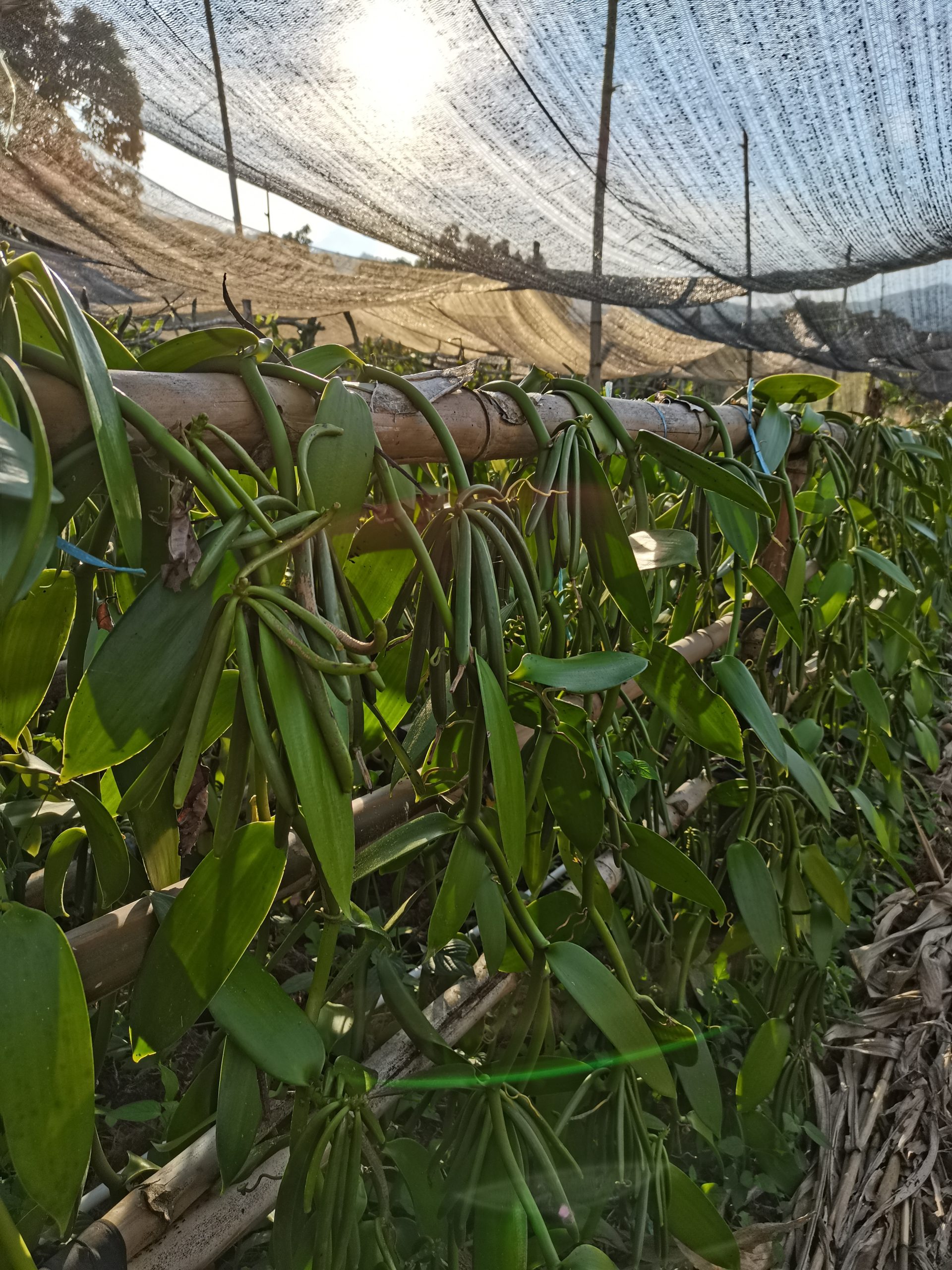
The 15-Month Commitment Behind Each Bean
Growing premium Indonesian vanilla beans is not a short-term crop. The Vanilla Planifolia flower opens for only 6-8 hours each morning, between 6 am and 9 am. A farmer must hand-pollinate every single bloom during that window — one flower, one movement, one bean. Miss the window and the flower dies unpollinated.
After successful pollination, the bean matures on the vine for 9 months. Harvest timing is critical: too early and the vanillin content never fully develops; too late and the bean splits. Our North Sumatra farms sit at 680 metres above sea level, where the temperature range and humidity slow the maturation process in ways that concentrate flavour compounds. Pak Irwan, who has farmed vanilla for 12 years in Simalungun, measures this daily.
“We watch the beans every single day in the final weeks. The colour changes from bright green to yellow-green, and the tip starts to show a darker shade. That is when we know. Pick too early and you lose everything — the vanilla needs its full time. I tell younger farmers: the bean decides the harvest date, not the calendar.”
— Pak Irwan, vanilla farmer, Simalungun, North Sumatra, 12 years cultivating Planifolia
After harvest, beans enter a 3-6 month traditional curing process — blanching in hot water, sweating under insulated blankets, and daily sun drying. The enzymatic reactions during sweating convert glucovanillin into free vanillin, the primary flavour compound. Our Sumatra Planifolia tests consistently above 2.5% vanillin content, against an industry average of 1.5-2.0% (Bythrow, 2005). That result is directly linked to proper farm-gate timing and patient curing — outcomes that only a direct sourcing model can reliably guarantee.
Fair Pricing: What 3× Commodity Rate Means in Practice
Indonesia produces approximately 2,300 tonnes of vanilla annually, making it the world’s second-largest producer after Madagascar (FAO, 2023). Yet Sumatran farmers have historically earned among the lowest per-kilogram returns in the global vanilla market, because commodity pricing rewards volume, not quality.
Vanillature pays farmers 3 times the prevailing commodity market rate. That premium reflects vanillin content, moisture accuracy, and physical bean grade — not just weight. Farmers who master moisture control and hit Grade A standards (30-35% moisture, vanillin above 2.0%) earn the highest returns. That direct incentive structure produces better beans. It also produces better lives: 500+ families across Sumatra and Papua now have a predictable, premium income from a crop they have invested 15 months of labour to produce.
Sun-curing beds in North Sumatra — traditional 3-6 month curing process
Certifications That Protect Every Link in the Chain
Direct sourcing carries legal and compliance weight at export. Vanillature holds FDA registration for the United States market and REX (Registered Exporter) certification for the European Union. These certifications require full traceability — every batch links to a specific farm cluster, harvest date, and curing batch record.
Our 5-stage quality sorting process checks each bean for length, moisture, vanillin level, visual grade, and physical defects before packing. Grade A beans meet 30-35% moisture and vanillin above 2.0%. Grade B beans carry 15-25% moisture and vanillin above 1.0% — still premium by international standards, but suited to different culinary applications. Buyers of our Indonesian vanilla beans direct source product receive a batch that has cleared every stage of that process, with documentation to match.
Community Impact Beyond the Farm Gate
Smallholder vanilla farming in Sumatra is overwhelmingly a family operation. The 500+ farmers Vanillature partners with are not employees of a plantation — they own their land, manage their vines, and make independent cultivation decisions. Our role is to provide agronomic guidance, fair pricing, and a guaranteed purchase contract at harvest.
That structure means farm income stays inside rural communities. Farmers reinvest in better shade trees, improved irrigation, and additional Planifolia planting stock. The FAO has identified direct-purchase relationships and fair trade premiums as the single most effective mechanism for improving smallholder income in high-value spice crops (FAO, 2023). Vanillature’s model operationalises that finding across 500+ farm families — one harvest at a time.
Vanillature team visiting farmer partners in Tapanuli, North Sumatra
Frequently Asked Questions
Taste the Difference Direct Sourcing Makes
Every bean in our range was hand-pollinated, harvested, and cured by one of 500+ farmer families in Sumatra or Papua — then tested through our 5-stage quality process before it reached you.
