


Vanilla Knowledge
Indonesia Vanilla Export Process: From Sumatra Farm to Your Warehouse
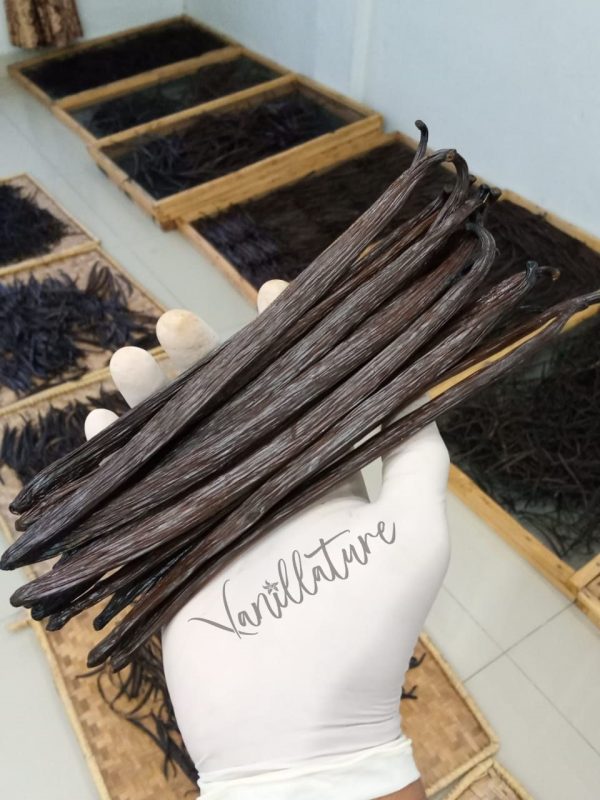
Aug
The Indonesia vanilla export process spans approximately 15 months — from a single hand-pollinated flower in Sumatra to a sealed, documented shipment landing at your warehouse door. Every step between those two points determines whether the vanilla inside tests above 2.5% vanillin or falls short of Grade A standard. Here is exactly how we do it at Vanillature.
Vine maturation before harvest
Traditional post-harvest curing
International shipping to buyer
Step 1 — Harvest: Timing the 9-Month Window
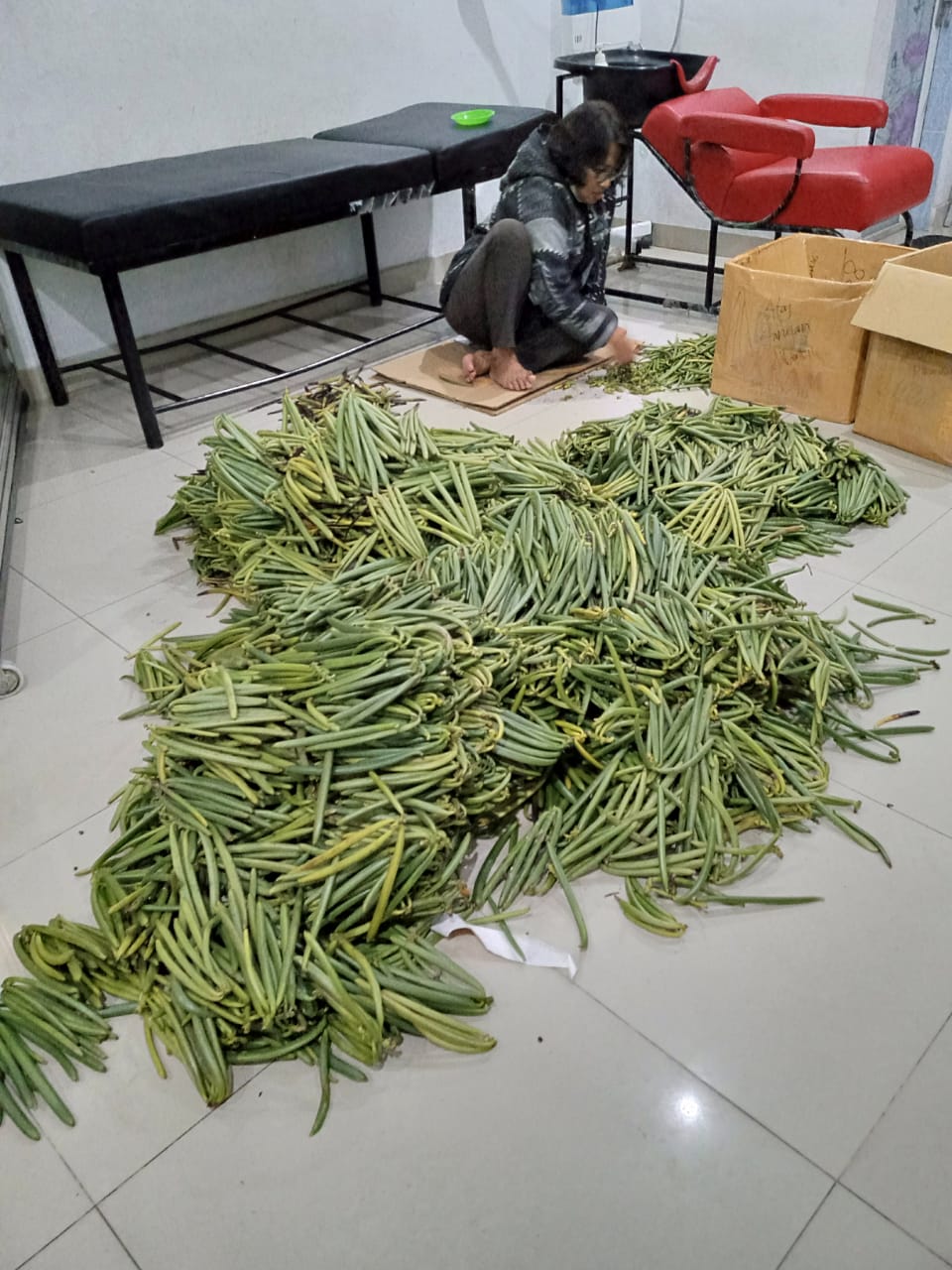
Vanilla beans are harvested exactly 9 months after successful hand-pollination. Pick them too early and vanillin precursors have not fully developed inside the bean. Pick them late and the pod splits, exposing the seeds and disqualifying the batch from Grade A classification.
At our North Sumatra farms sitting at 680 metres above sea level, farmers hand-check every vine from month 8 onward. The tip-yellowing signal — a faint golden tinge spreading from the distal end — marks the 48-hour harvest window. Missing it costs an entire vine’s 9-month effort.
Our 500+ smallholder farmers in Sumatra understand this timing intuitively after years of cultivation. Each pollination event is logged so harvest dates are predictable. Indonesia produces approximately 2,300 tonnes of vanilla annually, but Vanillature’s direct-farm model means we track individual vine records — not bulk estimates (FAO, 2023).
Step 2 — Blanching and Sweating: Where Vanillin Is Born
Freshly harvested green beans contain no free vanillin. The compound exists locked inside glucovanillin — a precursor molecule. Blanching breaks this lock. Beans are submerged in 63–65°C water for exactly 3 minutes, stopping enzymatic activity and initiating cell breakdown that releases glucovanillin into a convertible form.
Sweating follows immediately. Blanched beans are wrapped in wool blankets and held at 45–50°C for 36 to 48 hours. During this window, the enzyme β-glucosidase converts glucovanillin into free vanillin. Research by Havkin-Frenkel & Belanger (2011) in the Handbook of Plant and Crop Science confirms that the sweating stage is the biochemical foundation of vanillin development — without controlled temperature and duration, vanillin yields drop substantially.
This is where Sumatra Planifolia outperforms global averages. Our beans consistently test above 2.5% vanillin — against the industry average of 1.5–2.0% — because our sweating protocols hold temperature within ±1°C across the entire 48-hour cycle.
“In Papua we watch the colour change every morning during sweating. The beans go from bright green to deep chocolate brown over 2 days. When the colour is right, the smell tells you the vanillin is there. You cannot rush those 48 hours — the enzyme needs the full time to finish its work.”
— Bu Marlina, vanilla farmer, Papua, 8 years cultivating Tahitian variety
Step 3 — Sun Curing: 6+ Months of Slow Drying
After sweating, beans enter the curing phase — the longest stage of the Indonesia vanilla export process. Traditional sun curing at Vanillature runs for a minimum of 6 months, and often extends to 8 months for our Crystal Vanilla range.
Each morning, beans are laid out on raised racks under direct equatorial sun for 3 to 4 hours. Each afternoon, they return to shaded, ventilated storage. This cycle slowly reduces moisture while concentrating aromatic compounds. Grade A beans finish at 30–35% moisture content with vanillin above 2.0%. Grade B beans finish at 15–25% moisture with vanillin above 1.0%.
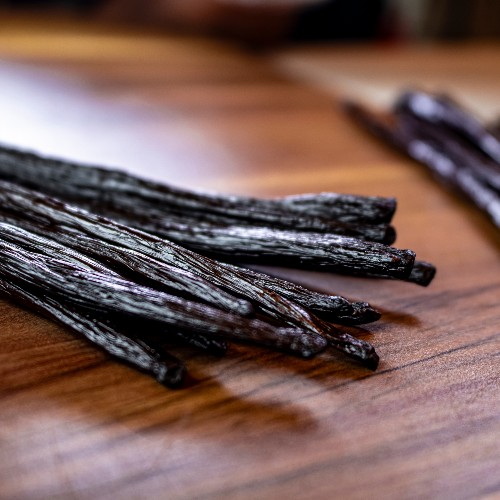
Our Crystal Vanilla undergoes the longest cure. The white vanillin crystals visible on the surface are concentrated vanillin that has migrated outward and recrystallised — a direct, visible marker of exceptional quality. Crystal Vanilla tests at 3.5–4% vanillin, the highest in our entire range.
Step 4 — 5-Stage Quality Sorting and Batch Testing
Every cured batch passes our 5-stage quality sort before export documentation begins. The stages assess length, moisture, visual uniformity, aroma intensity, and vanillin content. Beans failing any single stage are downgraded — not discarded — and reclassified to the appropriate grade.
Vanillature 5-Stage Sort Criteria
- Stage 1 — Length: Minimum 14 cm for Grade A; 10–13 cm accepted for Grade B
- Stage 2 — Moisture: Measured by calibrated moisture meter; 30–35% for Grade A
- Stage 3 — Visual: No splits, mould, or discolouration; surface sheen assessed
- Stage 4 — Aroma: Trained sorter confirms creamy, heliotropin-forward profile
- Stage 5 — Vanillin: Lab test confirms above 2.0% (Grade A) or above 1.0% (Grade B)
We test every batch. This is not a random-sample protocol. Every lot that leaves Vanillature carries a batch test result. Dunphy et al. (2020) in Food Chemistry established that vanillin concentration is the single most reliable quality predictor in Vanilla planifolia — which is exactly why we treat the Stage 5 test as non-negotiable.
Step 5 — Export Documentation and Belawan Port Dispatch
The Indonesia vanilla export process requires four core documents before a shipment leaves Sumatra. Each document is prepared simultaneously with final packing to avoid delays at Belawan port, Medan — the primary export gateway for all North Sumatra agricultural goods.
- FDA Prior Notice — Submitted electronically to the U.S. Food and Drug Administration a minimum of 2 hours before shipment for U.S.-bound orders. Required under the U.S. Bioterrorism Act for all food imports.
- Certificate of Origin (COO) — Issued by the Medan Chamber of Commerce, confirming Indonesian origin. Essential for preferential tariff claims in many buyer markets.
- Phytosanitary Certificate — Issued by Indonesia’s Plant Quarantine Authority (BBKP Belawan), certifying the shipment is free from pests and plant diseases. Required in virtually every vanilla-importing country.
- Commercial Invoice & Packing List — Includes HS Code 0905.10.00 (vanilla beans, not processed), net weight, and per-unit vanillin grade declarations.
From Belawan port, consolidated shipments move to Kuala Lumpur or Singapore hub before connecting to the buyer’s destination country. Air freight via FedEx or DHL reaches most international buyers within 5–14 days of dispatch. EMS postal service handles smaller wholesale samples at a longer transit window of 10–21 days depending on destination customs clearance speed.
Belawan port, Medan — primary export gateway for Sumatra vanilla shipments
Why Supply Chain Transparency Changes the Quality Equation
Most vanilla on the global market passes through 3 to 5 intermediary traders before reaching the end buyer. Each handoff adds cost, time, and opacity. The Indonesia vanilla export process at Vanillature collapses this chain to a single link: our 500+ farmers → our curing facility → your warehouse.
Direct sourcing means every batch has a traceable farm origin. It means the 9-month vine maturation is verified, not assumed. And it means the 6+ months of traditional curing cannot be shortcut by industrial kiln-drying — a practice that reduces curing time to weeks but drops vanillin content dramatically.
Indonesia sits second globally in vanilla production at approximately 2,300 tonnes per year (FAO, 2023). But production volume says nothing about quality. Our supply chain transparency exists because quality is built in the process — and the process has to be visible to be verifiable.
Frequently Asked Questions — Indonesia Vanilla Export Process
The full process takes approximately 15 months from pollination to a ready-to-ship batch. Beans require 9 months on the vine after hand-pollination, followed by blanching, sweating, and a minimum of 6 months traditional sun curing. Export documentation and port dispatch at Belawan, Medan then adds 3–7 working days before the shipment enters international transit.
Four documents are required for every international vanilla shipment: an FDA Prior Notice (for U.S. buyers, submitted minimum 2 hours before dispatch), a Certificate of Origin issued by the Medan Chamber of Commerce, a Phytosanitary Certificate from Indonesia’s BBKP Belawan quarantine authority, and a Commercial Invoice declaring HS Code 0905.10.00. Vanillature prepares all 4 documents simultaneously to eliminate port delays.
International shipping takes 5–14 days via FedEx or DHL air freight, routing through Belawan port, Medan to a connecting hub in Kuala Lumpur or Singapore before reaching the buyer’s country. EMS postal service is available for smaller sample orders at an extended transit window of 10–21 days, subject to destination customs processing speed. All shipments include tracking from dispatch.
Grade A Sumatra Planifolia from Vanillature consistently tests above 2.5% vanillin — compared to the global industry average of 1.5–2.0%. Grade A beans also carry a moisture content of 30–35%, the optimal range for maximum aromatic expression. Every exported batch carries a lab-verified vanillin test result, confirmed through our 5-stage quality sort (Dunphy et al., 2020, Food Chemistry).
Ready to Source Direct from Sumatra?
Skip the 5-trader chain. Vanillature ships Grade A vanilla beans — batch-tested, fully documented, and dispatched from Belawan port — directly to your warehouse in 5–14 days.
Vanillature (PT. Sumber Bukit Jaya) — Jl. Prof. H.M. Yamin SH No. 224M, Medan, North Sumatra 20234, Indonesia — +62 878-6986-1288